Nostalgia - Living Archive
Exhibit No. 4Louis and Lola: the photographs that found their mother
In April 1912 two small boys were carried off the rescue ship Carpathia and nobody knew who they were. They spoke French. The younger could barely speak at all. Their father had boarded the Titanic under a false name and drowned, so the name he travelled under was not theirs either. Reporters photographed them as evidence rather than as a portrait, and sent the pictures out in the hope that somebody who knew their faces would see one.
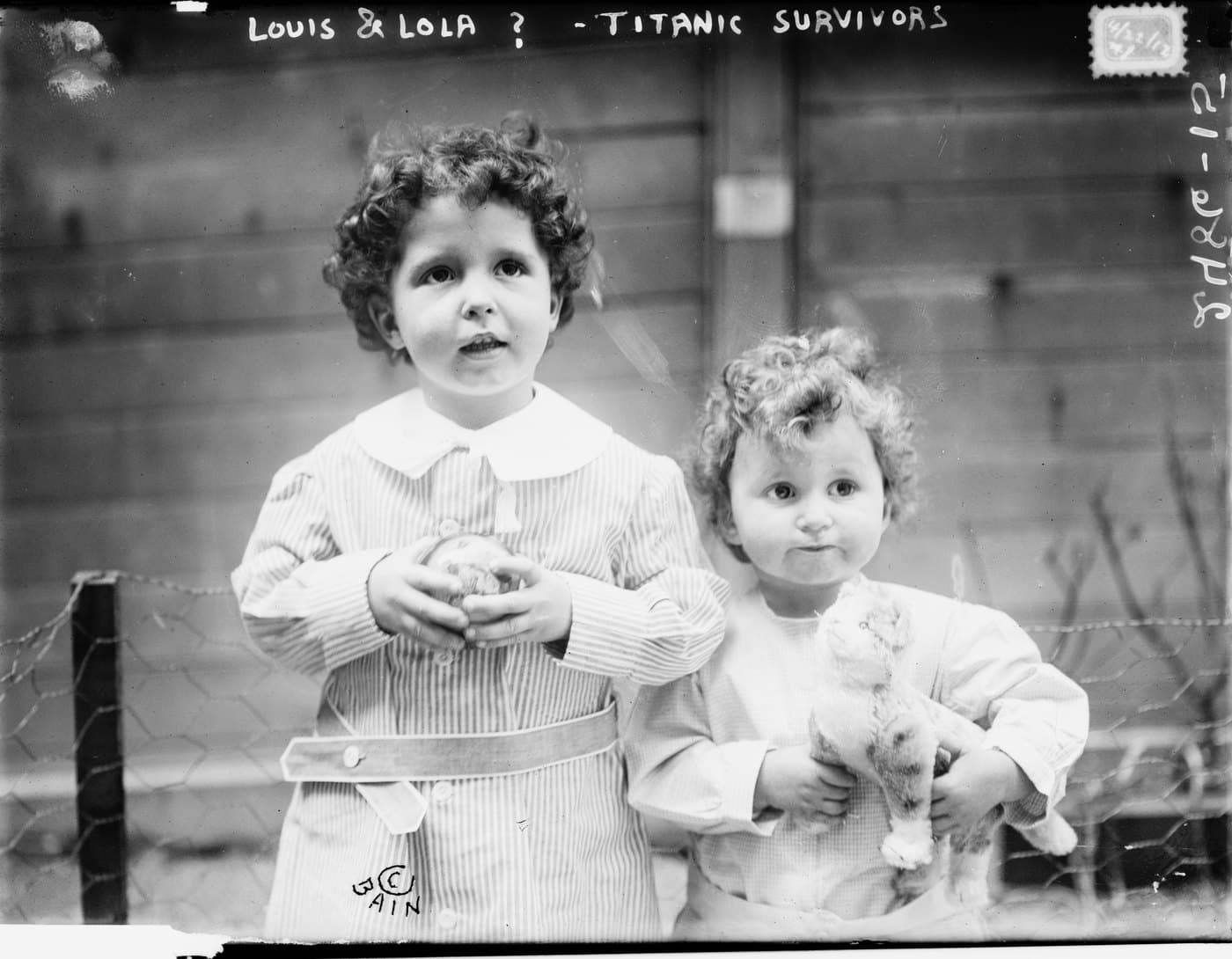
Michel, aged four, and Edmond, aged two. Bain News Service, April 1912. The question mark is the news agency’s own, written onto the plate.
Somebody recognised them
The Library of Congress record for one of these frames states the outcome in a single line: the photograph was taken “before the orphans of the Titanic were correctly identified and returned to their mother”. Their mother, Marcelle Navratil, was in France. She did not know her sons had been on the ship. She saw a published photograph, recognised her own children, and they were sent back to her.
That is the entire mechanism this product is built on, performed in 1912 with these exact photographs: publish the picture, let somebody who knows the face say so, and the name comes back. The archive still files them under “Louis & Lola” — the nicknames their father used with a false surname — and it never removed the question mark.
The same app, pointed at the public record
Every photograph was uploaded, cropped, captioned and restored through the product any visitor can use. Nothing here was done in a tool you cannot open yourself.
- 01
Fourteen photographs, one rights statement at a time
Every photograph here is from the George Grantham Bain Collection at the Library of Congress, whose rights advisory reads "No known restrictions on publication". Photographer, date and licensing basis were recorded per photograph from the Library's own item record before anything was uploaded, and the full manifest is public in our repository. Nothing on this wall is described from memory.
- 02
The caption is written on the photograph
Bain News Service inked its captions straight onto the glass negative, because the caption had to travel with the plate. So "Louis & Lola ? — TITANIC SURVIVORS" is physically part of the picture you are looking at, in 1912 handwriting, question mark included. We cropped the plate border and left the writing exactly where the news agency put it. The archive's uncertainty is not something this exhibit claims. It is something you can read.
- 03
Names only where the record has them
Nine plaques carry names because the Library's record carries them: Michel and Edmond Navratil, Stuart Collett, Margaret Brown, Henry Frauenthal, Karl Behr, Arthur Rostron. Two dates were left off on purpose. Stuart Collett is filed as "1912 April 13 [?]" — the archive's own question mark, and two days before the ship sank, which cannot be right for a photograph taken aboard the rescue ship. Margaret Brown is dated only to a thirty-year span. A plaque that invents precision is worse than a plaque that admits it does not know.
- 04
Restored almost nowhere, and here is why
All fourteen were run through a Museum restore pass in August 2026, then judged against five conditions written down before the results were seen. One passed. Thirteen did not. Most simply were not visibly better at the size you view them: these are sharp glass negatives and there was little to repair. One was rejected outright because the restore added stippled skin texture to three faces that the soft original could not have contained. Sharpening a face until it invents skin is not restoration, and this wall would rather show you the photograph the archive actually holds. That pass is from August 2026. It is not a promise about the restore you get today.
 RestoredThe scan
12 plaques on this wall are still asking
A crowd waiting at the pier in New York for news. Survivors in a lifeboat, rowing. People photographed on the worst day of their lives, and the record kept none of their names. If you recognise somebody, the plaque takes answers and you do not need an account.
All fourteen photographs are from the George Grantham Bain Collection, Library of Congress, which states “no known restrictions on publication”. Per-photograph sourcing, licensing basis and the crop applied to each plate are published in our repository.
More exhibits: Ellis Island, Seven Hungry Children, and Queen Victoria’s family.