Nostalgia - Living Archive
Exhibit No. 3Seven Hungry Children: American Families, 1936-1939
In the summer of 1936 the Farm Security Administration photographed the same crisis two ways. Dorothea Lange followed the road west and described what she found: destitute pea pickers, a migrant worker’s family, seven hungry children. Walker Evans sat in three houses in Hale County, Alabama, and wrote down who was in front of him. Same programme, same year, same country — and one set of families got their names recorded while the other did not.
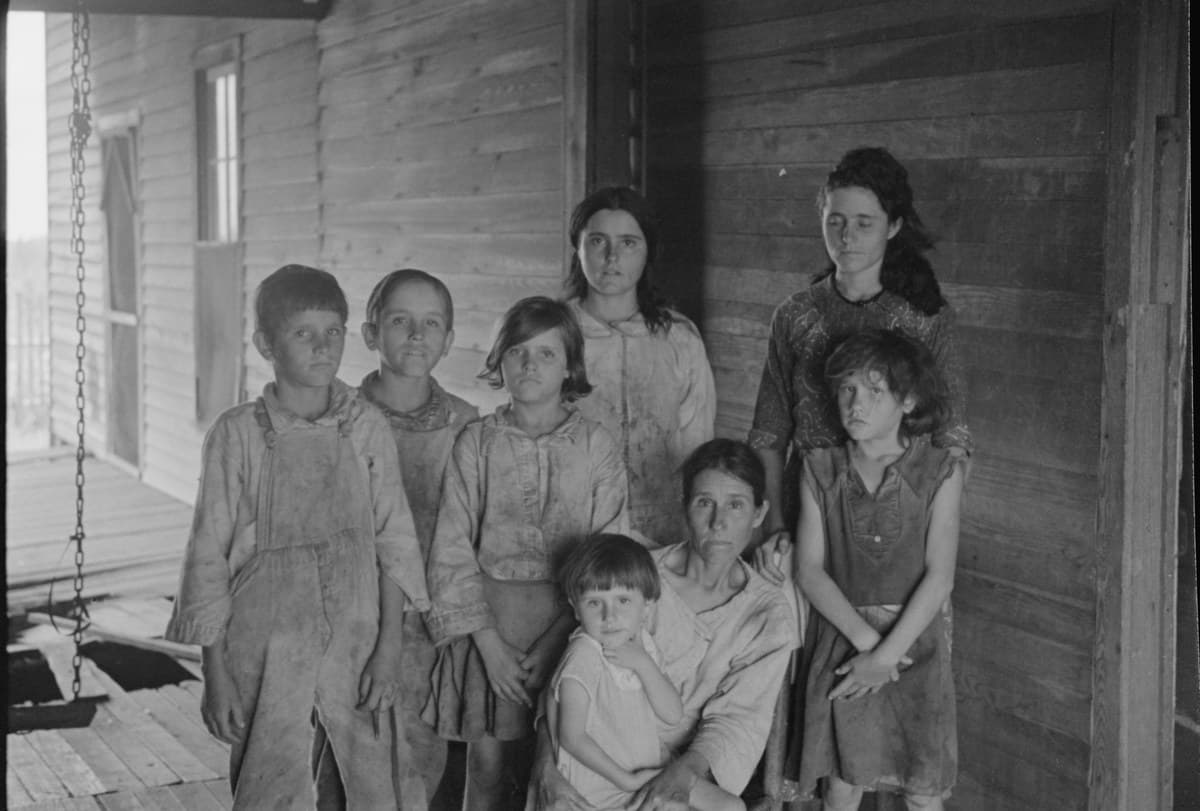
The Frank Tengle family, Hale County, Alabama, summer 1936. Evans recorded the father’s name; the children on the porch with him are unnamed in the record. Photograph by Walker Evans, public domain, Library of Congress.
The same app, pointed at the public record
Every photograph was uploaded, cropped, captioned and restored through the product any visitor can use. Nothing here was done in a tool you cannot open yourself.
- 01
Fifteen photographs from the Library of Congress
Every photograph here is a Farm Security Administration negative held by the Library of Congress, in the public domain because it was made by federal employees on federal time. Photographer, date, place and licensing basis were pinned per photograph before anything was uploaded. The masters are 10 to 60MB TIFF scans; nothing smaller exists at usable quality, because the largest JPEG the archive publishes is 1024 pixels wide.
- 02
Thirteen of fifteen needed a crop before they were photographs again
The Library's masters are scans of the original negatives, which means film rebate, sprocket edges and the archive's own pencilled numbers around the image. Left alone, the wall would have hung the scan rather than the photograph. Each frame was cropped to the picture Lange and Evans actually composed, and the crop is recorded in the manifest rather than done silently.
- 03
Plaques that stop where the record stops
Lange's captions describe a condition: “Destitute pea pickers in California”, “Migrant agricultural worker’s family”. In Hale County, Alabama, Walker Evans wrote down names — Allie Mae Burroughs, Floyd Burroughs, Bud Fields, Frank Tengle. Then we fact-checked our own plaques against the Library's records and found two more names we had written off as lost, one of them credited to a family member who wrote in. Eight of the fifteen are named. Of the seven that are not, the wall asks about the four with somebody in the frame — two abandoned farms and a roadside camp have nobody in them to ask about, and a plaque that asked anyway would be a question nobody could answer.
- 04
Restored where restoration helped, and only there
All fifteen were run through a Museum restore pass in August 2026, then judged by eye against five conditions written down BEFORE the results were seen. Two passed and carry a before/after slider on this page. Three were rejected because the model invented detail on a face — including freckles on Allie Mae Burroughs that do not exist in the negative. One came back byte-for-byte identical to the original: nothing ran, and it would have scored best of all fifteen on every size measurement. The wall shows the photograph as it survives; the restoration is something you pull across it. That pass is from August 2026. It is not a promise about the restore you get today.
 RestoredThe scan
Seven families on this wall have no name
Not because the archive lost them. Because the person holding the camera wrote down a condition instead of a name, and nobody went back. It was eight until we fact-checked our own plaques against the Library’s records: two of these families had already been identified, and one of those identifications is credited simply to “a family member”. Somebody’s relative recognised them and wrote in. That is the whole mechanism, working, decades late. If you recognise a face on this wall, the plaques take answers.
Photographs by Dorothea Lange, Walker Evans and Arthur Rothstein for the Farm Security Administration, 1936–1939. Public domain, held by the Library of Congress Prints & Photographs Division. See the other exhibits in the museum, or read about the archival approach.